

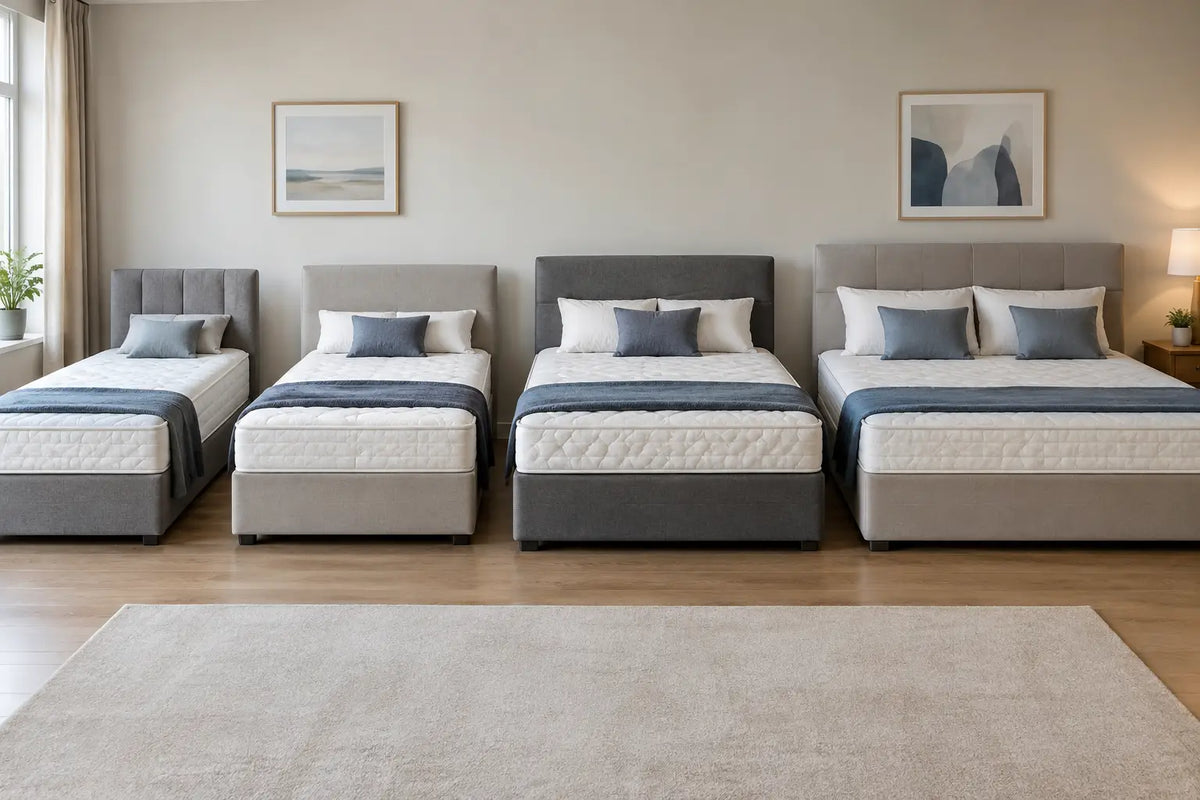
A mattress should feel generous in every sense: enough personal space for restorative sleep, enough visual presence for the room, and the right proportions beneath a beautifully upholstered bed. UK mattress sizes are familiar at a glance, yet choosing between them deserves more consideration than simply selecting the largest size that will fit through the door.
For a considered bedroom, the mattress is the starting point. Its dimensions influence the bed frame, headboard scale, linen, bedside furniture and, ultimately, how comfortably the room lives day to day.
UK mattress sizes at a glance
The dimensions below refer to the sleeping surface of a standard UK mattress. Bed frames are always larger, sometimes considerably so, particularly with deep upholstery, wide side rails or a statement winged headboard.
| Mattress size | Dimensions | Best suited to |
|---|---:|---|
| Small single | 75 x 190 cm | Compact guest rooms and children’s rooms |
| Single | 90 x 190 cm | One sleeper, growing children and guest bedrooms |
| Small double | 120 x 190 cm | One sleeper wanting extra room, or occasional two-person use |
| Double | 135 x 190 cm | Couples in more compact bedrooms |
| King size | 150 x 200 cm | Couples seeking greater comfort and proportion |
| Super king | 180 x 200 cm | Spacious principal bedrooms and undisturbed shared sleep |
An emperor mattress, usually 200 x 200 cm, is also available from specialist makers, though it is not a standard UK size. It can be exceptional in a large bedroom, but requires careful planning around access, bespoke linen and the surrounding furniture.
Choosing mattress sizes for the way you sleep
A mattress should accommodate the sleeper, rather than asking the sleeper to adapt. For one person, a single or small double can be perfectly practical, but a larger mattress often brings a quieter, more relaxed quality to the room. A small double is especially appealing in a guest bedroom where a single bed would look slight, yet a full double may compromise circulation.
For couples, the key question is not simply whether two people can fit on the mattress. It is whether each person has enough uninterrupted space to sleep well. A standard double gives each sleeper 67.5 cm of width, less than a single mattress. It remains a sensible choice in a city flat or a more compact period property, but it is a compromise.
A king size offers a notably more comfortable division of space, alongside the extra length many adults appreciate. It is often the most balanced choice for a principal bedroom: substantial enough to feel luxurious, without automatically dominating the plan. If one partner is a restless sleeper, has a different schedule, or simply values room to stretch, the move from double to king is usually felt immediately.
A super king gives each sleeper the equivalent width of a single bed. For many couples, particularly those investing in a long-term home, it is the benchmark for truly generous shared sleep. It also permits two separate 90 x 200 cm mattresses within one bed frame, allowing each side to have its own tension while maintaining the appearance of one composed bed. This is an elegant solution where comfort preferences differ.
Let the room determine the proportion
The largest mattress is not always the most successful choice. A bed needs clearance around it to feel inviting rather than imposing. As a guide, aim for roughly 60 to 75 cm of clear walking space at the sides and foot of the bed where the room allows. This creates enough room to dress the bed, open drawers and move comfortably around it.
Measure the room at its narrowest points, not only wall to wall. Radiators, chimney breasts, inward-opening doors, window seats and fitted wardrobes all alter the usable footprint. Consider the route into the bedroom too. A super king mattress may be manageable in a generous new-build staircase, but more difficult in a top-floor period conversion. Split mattresses can make access easier without sacrificing the final scale of the bed.
The overall bed dimensions matter just as much as the mattress itself. An upholstered ottoman base may extend only modestly beyond the mattress, while a substantial sleigh bed or deeply padded frame can add significant width and length. If you are considering a floor-to-ceiling headboard, measure the visual wall as well as the floor plan. The result should feel intentional, with bedside tables and lighting given room to breathe.
A note on ottoman beds and storage
Storage beds are especially valuable where a bedroom must work hard. However, an ottoman’s lifting mechanism needs clear space at the foot or side, depending on its opening direction. A beautifully sized super king is less practical if a bench, chest or fitted cabinetry prevents it from opening fully.
For rooms with limited floor area, a king-size ottoman can often offer a more sophisticated solution than a super king with no useful storage. It preserves a generous sleep surface while keeping seasonal bedding, spare pillows and luggage discreetly out of sight.
Depth, comfort and the finishing details
Width and length are only part of the decision. Premium mattresses are often deeper than entry-level designs, commonly around 25 to 35 cm and sometimes more. This changes the height of the finished bed, the depth of fitted sheets required, and the relationship between the mattress and headboard.
A deeper mattress can create a wonderfully tailored, hotel-like appearance when paired with a correctly proportioned headboard. Equally, it may sit higher than expected on a divan or ottoman base. Consider who will use the bed: ease of getting in and out matters, particularly in a guest room intended for older family members.
Do not assume that all king or super king mattresses have identical corner profiles and depths. Before selecting linen, check the exact dimensions of the chosen mattress and allow for a mattress protector. Fine bedding should drape rather than strain across the corners, especially on a deep, natural-filled mattress that benefits from breathable layers.
When standard sizes are not enough
Some bedrooms call for a more individual approach. A particularly wide room, a grand headboard design, or a tall client may justify an emperor or made-to-order dimension. Bespoke sizing can also be worthwhile for unusual architectural spaces, although it brings practical considerations: replacement mattresses, fitted sheets and protectors may require advance ordering.
There is value in staying with a standard size when possible. It offers the widest choice of linen and accessories, makes future changes simpler, and allows a bed to evolve with the home. Bespoke is best chosen because it serves the room and the sleeper, not merely because it is available.
Before placing your order
Confirm the mattress size, the external dimensions of the bed, and the delivery route through your property. It is wise to mark out the proposed footprint on the floor with tape, including bedside tables, so you can see the true circulation space rather than relying on a plan.
Also decide whether the mattress should be one piece or split. A split super king can be considerably easier to manoeuvre upstairs, while two separate mattresses may be preferable for partners with different comfort requirements. A single continuous mattress, by contrast, has no central join and can suit those who prefer an uninterrupted sleeping surface.
For a bedroom designed to endure, mattress size is a decision in proportion rather than excess. Choose the scale that gives you freedom to sleep, room to move and a bed that feels naturally at home in its setting. The Natural Collection team can help you consider those details before the final choice is made, so the finished room is as comfortable as it is composed.
Share:
Upholstered Bed Quality Review for Lasting Luxury
Bedroom Upholstery Fabric Guide for Refined Homes