

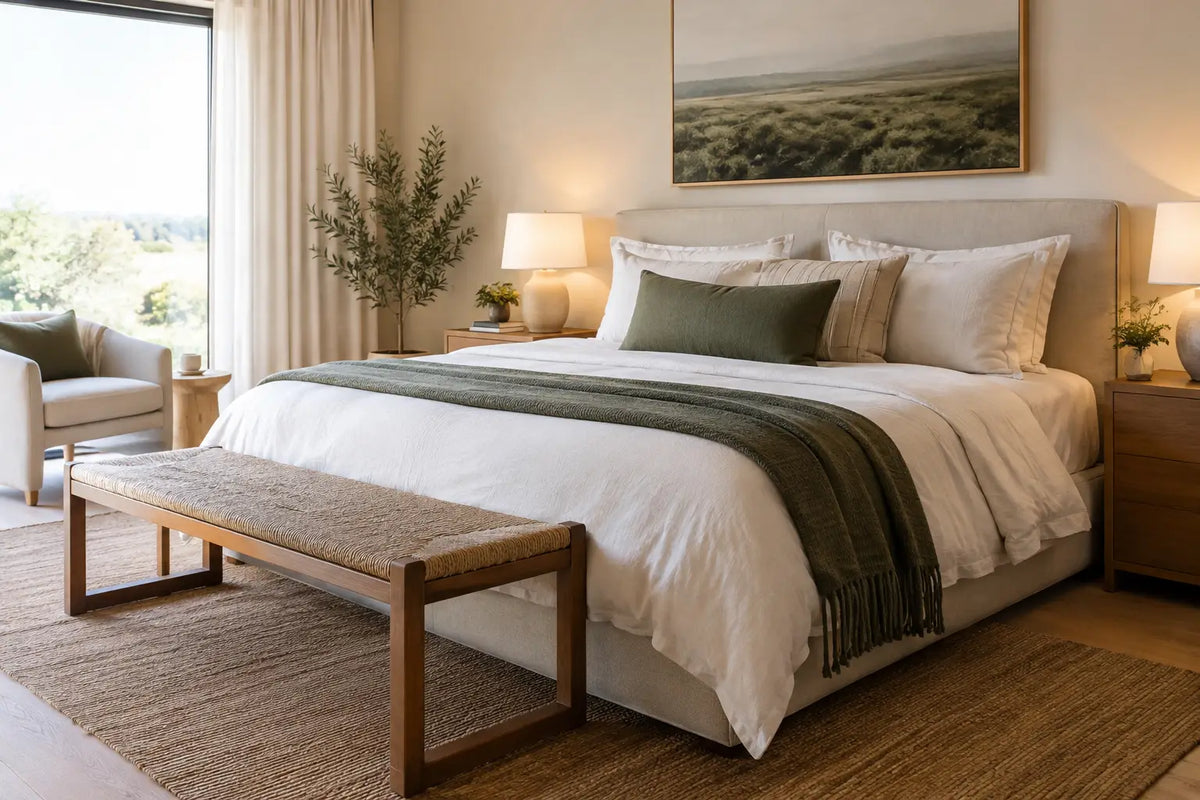
A beautiful bedroom is rarely created by adding more. It is created by making a small number of excellent decisions - about scale, comfort, materials and the way the room needs to serve you. This designer bedroom guide is for those who want their private space to feel as considered as the rest of their home: restful at night, composed by day and tailored rather than merely furnished.
The bed will naturally lead the scheme, but the finest rooms do not stop there. Mattress comfort, upholstery, headboard height, bedside proportions, lighting and storage all need to work together. The result should feel quietly resolved, with every element earning its place.
Begin with the bed, not the accessories
In a bedroom, the bed is both the largest visual object and the piece that most directly affects daily life. Choose its size first, then allow the room to respond to it. A super king offers a generous, hotel-like sense of ease, but it should not leave only a narrow passage around the sides or at the foot. In a more compact room, a king size bed with a carefully chosen headboard can look more assured than an oversized frame pressed against every wall.
As a useful starting point, aim for clear circulation around the bed wherever the layout allows. You should be able to move easily, open drawers or wardrobes without conflict, and make the bed without turning the room into an obstacle course. If a bed must sit close to a wall, balance the layout elsewhere with a larger bedside table, a wall light or a considered reading chair.
The bed’s silhouette matters as much as its footprint. A low, deeply upholstered frame can bring calm to a room with high ceilings or ornate architectural features. A taller divan base and dramatic headboard may be more appropriate where the room needs a stronger focal point. There is no universal rule: proportion is always relative to the space, ceiling height and the other furniture already in the room.
Designer bedroom guide: choose comfort with conviction
A handsome bed cannot compensate for a mattress that does not suit the people sleeping on it. Mattress selection deserves the same attention as fabric and finish, particularly for couples with different preferences. Your usual sleeping position, body weight, temperature preferences and sensitivity to movement all play a part.
A medium tension is often an appealing starting point for couples, offering balanced support with enough cushioning for side sleepers. Those who sleep predominantly on their front or back may prefer a firmer feel, while a softer mattress can be welcome for lighter bodies and dedicated side sleepers. Yet labels alone do not tell the entire story. Layering, natural fillings, spring construction and upholstery depth can make two mattresses with the same stated tension feel entirely different.
For a principal bedroom, consider the mattress and base as a single comfort system. A quality divan base can support the mattress evenly and create a more polished profile than an improvised frame. If you favour a slatted bedstead, check that the mattress specification is compatible with the spacing and type of slats. This is a detail easily missed during a design-led purchase, but it has a bearing on both feel and longevity.
For many homes, the most practical luxury is an ottoman bed. It keeps spare bedding, seasonal linens and suitcases close at hand without introducing additional furniture into the room. Choose end-opening or side-opening storage according to the layout, ensuring there is sufficient clearance to lift the base comfortably. An ottoman is particularly effective in a London flat or a guest room, though it is equally valuable in a larger home where visual calm is the priority.
Use upholstery to set the room’s mood
Upholstered beds create softness before the first cushion is placed. They also offer an opportunity to establish the room’s character with much greater precision than a painted wall alone. Linen-blend textures, bouclé, velvet and woven wool each respond differently to light and touch.
A textured neutral fabric gives a bedroom enduring appeal, especially where the architecture is already distinctive. Consider warm ivory, mushroom, oat or stone rather than a stark white, which can feel severe under evening lighting. Richer shades such as tobacco, olive, ink or deep aubergine bring intimacy and depth, but they work best when repeated subtly elsewhere - perhaps in a curtain leading edge, a lampshade or the binding of a bench.
Fabric samples are worth viewing in the bedroom itself. Hold them against the existing flooring, wall finish and curtains in both morning and evening light. The colour you admire on a screen can shift dramatically beside warm timber, cool marble or a north-facing window. This is also the moment to assess practicality. Pale velvet looks wonderfully luminous, but a family home with pets or a bedroom frequently used by young children may be better served by a forgiving woven upholstery.
Detail should be deliberate, not decorative for its own sake. Deep buttoning gives a traditional, architectural quality; channel stitching feels tailored and contemporary; a plain, generously padded headboard offers restraint. Match the detail to the home rather than following a passing trend. In a period house, a tall, framed headboard can echo original joinery. In a newer property, clean lines and tactile fabric often provide the warmth the architecture lacks.
Get the headboard height and width right
A headboard is an anchor, not an afterthought. It should relate confidently to the bed and the width of the wall behind it. A headboard that is wider than the mattress can make a standard bed feel more substantial, particularly when it incorporates the bedside tables into a single composition. Conversely, a very wide design in a narrow room may leave the space feeling compressed.
Height should respond to the ceiling and what sits above the bed. If there is a low window, picture rail or sloping roofline, a lower headboard will keep the room balanced. Where there is generous wall height, a tall upholstered design can create the sense of arrival associated with a well-designed suite. Allow room for bedside lighting and artwork, rather than forcing competing elements into one area.
If you enjoy reading in bed, prioritise a generously padded headboard with enough height above the pillows to be genuinely comfortable. It is a modest consideration on paper, but one you will appreciate every evening.
Build the room in layers, with restraint
Once the bed, mattress and headboard are settled, the rest of the bedroom becomes easier to organise. Bedside tables should be useful, not merely symmetrical. They need enough surface for a lamp, water and the book currently being read, as well as discreet storage for the essentials you prefer not to see. Their height should sit close to the top of the mattress for a natural reach.
Lighting deserves at least three sources: ambient light for entering and dressing, bedside light for reading, and softer accent light for the final hour of the day. Wall-mounted reading lights free up the bedside surface and offer a neat solution where tables are compact. A dimmer is one of the simplest ways to make a bedroom feel more considered, allowing the atmosphere to change without changing the scheme.
Treat window dressings as an essential layer of sleep comfort. A lined curtain with blackout interlining can improve darkness, acoustics and the perceived warmth of the room. In rooms facing the street, it also provides privacy without the visual hardness of a blind alone. Choose a fabric that has enough weight to hang beautifully, but do not assume heavier is always better: a small bedroom may benefit from a lighter weave and a carefully chosen lining.
Finally, resist filling every corner. A bedroom should have some visual breathing room. One exceptional chair, an upholstered bench at the foot of the bed, or a finely proportioned chest of drawers is more persuasive than several smaller pieces. Art should be personal and calm enough to live with at close range. Scent, flowers and a neatly folded throw can finish the space, but they should never be asked to disguise unresolved choices underneath.
Make the purchase experience as considered as the room
A bespoke-looking bedroom depends on decisions made before delivery day. Confirm access routes, stair turns, lift dimensions and the final room measurements, particularly when ordering a large headboard or a super king bed. Check whether assembly and old-bed removal are required, and plan delivery around decorating, flooring and curtain installation where possible.
At The Natural Collection, the ability to request fabric swatches and receive guidance on bed sizes, storage configurations and mattress comfort helps turn a high-consideration purchase into a confident one. Take the time to compare options in context. The right choice should satisfy the eye immediately, but it should also remain practical after years of late mornings, changing seasons and real life.
A designer bedroom is not a showroom recreated at home. It is a room that understands how you live, supports how you sleep and feels unmistakably yours when the door closes.
Share:
Curved Headboard Trends for Refined Bedrooms
How to Match a Headboard to Your Bed with Ease